Saved prompt text
The collected text is preserved as saved. It may be an excerpt; check the linked post for the creator’s full context.
[Sport]: {trail running / swimming / skateboarding / cycling}
[Action]: {specific athletic movement}
[Force]: {terrain / water resistance / impulse / airflow}
[Scene]: {environment}
[Accent Color]: {color}
[Title]: {title}
[Keywords]: {3 short words}
[Format]: 9:16 vertical

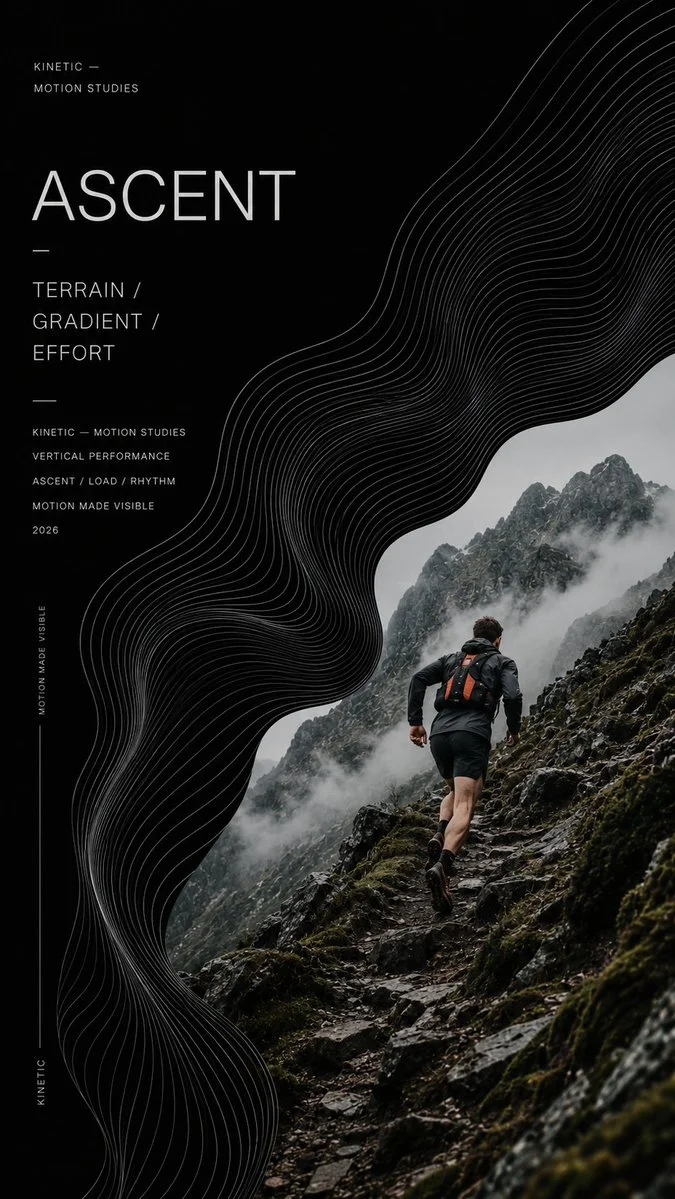
Create an experimental sports editorial poster that visualizes the invisible forces created by movement.

Use a deep black background with large negative space, realistic action photography, organic photo cropping, minimal typography, and one continuous flowing-line system.

Capture the athlete in a natural, believable moment of motion. Keep realistic anatomy, equipment, materials, skin texture and healthy natural skin tone. The athlete should not look at the camera.

Let the graphic lines originate naturally from the action or environment:

ACTION → FORCE → FLOW

For example, terrain shapes the lines around a runner, water currents follow a swimmer, impulse rises from a skateboard takeoff, or airflow bends around a cyclist.

Use 30–60 long, thin, smooth continuous curves. Keep them elegant, evenly spaced and gradually changing in curvature. Let the lines compress, stretch and release according to the force of the movement.

Keep all lines continuous and clean — no broken segments, random intersections, short fragments, nodes, particles, polygon networks or technical UI graphics.

Flow lines should follow around the athlete’s silhouette rather than crossing exposed skin or obscuring the body.

Use a restrained palette: black, neutral photographic tones, white/gray lines, plus one subtle accent color.

The final image should feel like premium sports culture × generative graphic design, where the lines reveal the beauty, force and rhythm of athletic motion rather than simply decorating the photograph.Before you create
Customize the subject, text and any template variables before generating.
The current Banana 2.1 studio generates from text with Nano Banana 2.1 Pro. Reference-image uploads and editing are coming soon. If you follow a reference suggestion above, use an editor that supports it. A source example’s model label does not mean that model is available here. Results will vary.
Creator & source
Larus Canus · @MrLarus
Read the original post ↗